

News Center
News
Leave Us a Message
Double-head chamfering machine: a high-efficiency piece of equipment for precision profile processing.
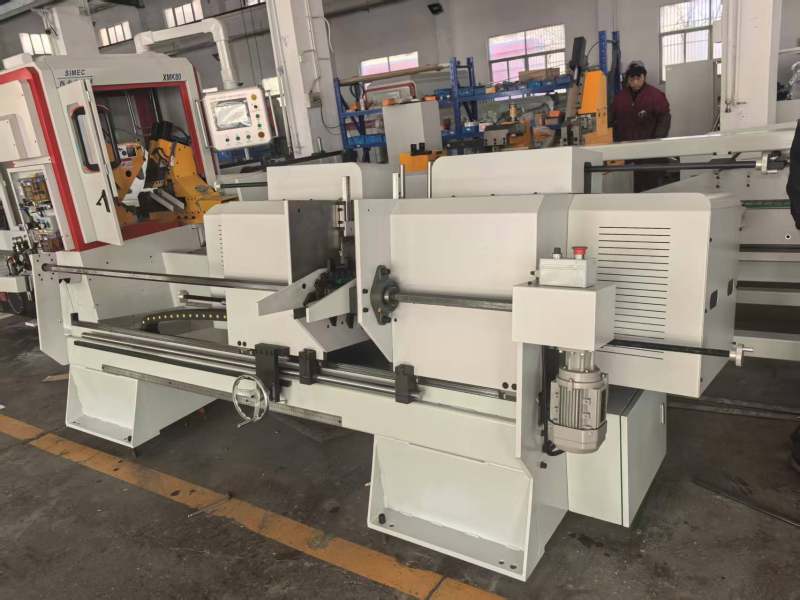
In the metal processing and machinery manufacturing industries, chamfering is a basic process in the precision machining of workpieces, which directly affects the assembly accuracy and appearance quality of parts. The double-head chamfering machine is a precision automated processing equipment designed for tubes, bars and profiles, and is also the core equipment for modern mass chamfering production.
Unlike traditional single-head chamfering machines, the biggest advantage of the double-head chamfering machine is its simultaneous operation at both ends. Relying on a precise transmission structure, coupled with rubber drive wheels, a clamping and positioning device, and a servo feed system, the machine can fix the workpiece position while simultaneously chamfering and deburring the inner and outer corners and end faces of both ends. The entire operation eliminates the need for manual workpiece rotation; precise mechanical control ensures the stability of the processing, fundamentally solving the industry pain points of misalignment, dimensional deviations, and low efficiency in traditional chamfering processes.
II. Core Performance and Processing Advantages
With the upgrading of manufacturing towards refinement and automation, traditional manual and single-head chamfering equipment can no longer meet the needs of mass production. Double-head chamfering machines, with their multiple performance advantages, have become the preferred equipment for various processing production lines, offering extremely high overall cost-effectiveness.
Firstly, processing efficiency is significantly improved. The equipment can achieve simultaneous processing at both ends with a single clamping, nearly doubling production efficiency compared to single-head equipment. This greatly shortens the chamfering cycle for pipes and bars, making it suitable for large-scale standardized production. Secondly, processing accuracy is stable and controllable. Equipped with a servo adjustment system, the chamfering size and feed speed can be precisely set via a touchscreen, eliminating the need for frequent mold changes. The workpiece chamfering angle is uniform, and the cut is smooth and burr-free, effectively avoiding dimensional errors caused by manual operation. Furthermore, the equipment is highly adaptable, capable of processing round pipes and solid bars made of various materials such as carbon steel, stainless steel, aluminum alloy, and copper alloy, meeting the processing needs of various conventional and non-standard workpieces.
III. Main Application Areas and Industry Value
With its high efficiency, precision, and wide adaptability, the double-head chamfering machine has been widely adopted in various precision manufacturing fields, becoming an indispensable processing equipment and providing strong support for improving quality and efficiency in the industry.
In the automotive manufacturing industry, the equipment is mainly used for chamfering the end faces of components such as brake lines, engine oil lines, and steering tie rods to ensure a good fit during subsequent welding and assembly. In the hardware processing and machinery manufacturing industries, it is often used for the precision machining of shafts, fasteners, and fitness equipment accessories to improve product aesthetics and operational stability. Furthermore, double-head chamfering machines are also suitable for precision pipe processing in high-end fields such as aerospace, medical devices, and fluid piping, rigorously meeting the production standards for high-precision workpieces.
Overall, the double-head chamfering machine not only simplifies the chamfering process of profiles and reduces labor costs and scrap rates, but also promotes the standardization and automation of the chamfering process. It is a core processing equipment with great practical value in the process of the manufacturing industry's refined transformation.